

This year, the Philippines is reeling from almost P10 billion in agricultural loss* and reduced power supply in Mindanao. While other factors have been at play, El Niño has been a major contributor to these situations.
Though El Niño is expected to gradually weaken by March and end in May this year, it is important to know the science behind this climatic phenomenon. Proper knowledge and information are key to solutions that will minimize its impact on our business as well as national socio-economic progress.
We will discuss the hard numbers and a solid analysis of this year’s El Niño in the next installment of this article. For now, we present a historical background and scientific explanation behind El Niño to understand the wider context of its global and local effects.
“The Little Boy”
Before weather satellites existed, Peruvian fishermen have been observing a phenomenon which comes and goes every couple of years. Waters off South American coast were eerily warmer than usual, and this affected their fishing.
They named this phenomenon “El Niño” or “the boy child” in reference to the child Jesus, as it usually occurred during Christmastime.
In the early 1980s, weather satellites across the Pacific observed and confirmed this climatic anomaly and El Niño was then referred to as the “Warm Episode” of the El Niño-Southern Oscillation (ENSO). This signified that atmospheric pressures, sea-surface temperatures, and the general wind direction of the Pacific Ocean changed.
ENSO is divided into three phases: (1) Neutral, (2) El Niño, and (3) La Niña. El Niño is simply the weakening of the east-to-west trade winds, or even a reverse of it. When this happens, the warmer waters, including the warm ocean current, move into the Central and Eastern Pacific Ocean, and reach the western coast of South and Central America. Because of the warm moisture produced from this activity, rain clouds and thunderstorms develop.
El Niño recurs every 2 to 7 years and typically persists for 9 to 12 months. It usually starts to develop during the period of April to June, and tends to reach its peak or maximum strength during December to February.
Below are graphics showing differences between an El Niño and Neutral Events (see Figure 1).
Effects for the Philippines
When a strong El Niño occurs in the Pacific Ocean, the Philippines suffers from droughts resulting in various kinds of sanitary and health diseases. During the wet season, rain is somehow below average.
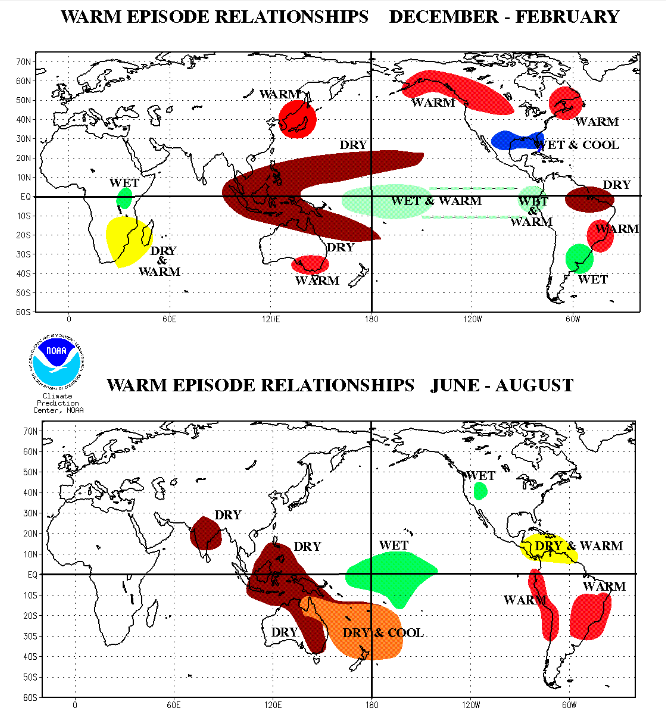
Below is another set of graphics showing the effects of El Niño on a global scale (see Fig. 2)
(TO BE CONTINUED IN NEXT ISSUE)
*Source: BusinessWorld