By Ginggay Hontiveros-Malvar Chief Reputation and Sustainability Officer, Aboitiz Group President, Aboitiz Foundation
This column is adapted from a speech I recently delivered to mayors participating in the Leaders for Excellence and Public Service Open Government Fellowship Program (LEAP). LEAP convenes a cohort of first-term mayors and supports them in their early years in public service. The program is designed to cultivate leadership that is transparent, participatory, accountable and data-driven.
Thank you for inviting me. It is truly a privilege to be with a group of young leaders who have chosen public service and who carry the responsibility of shaping the future of their communities.
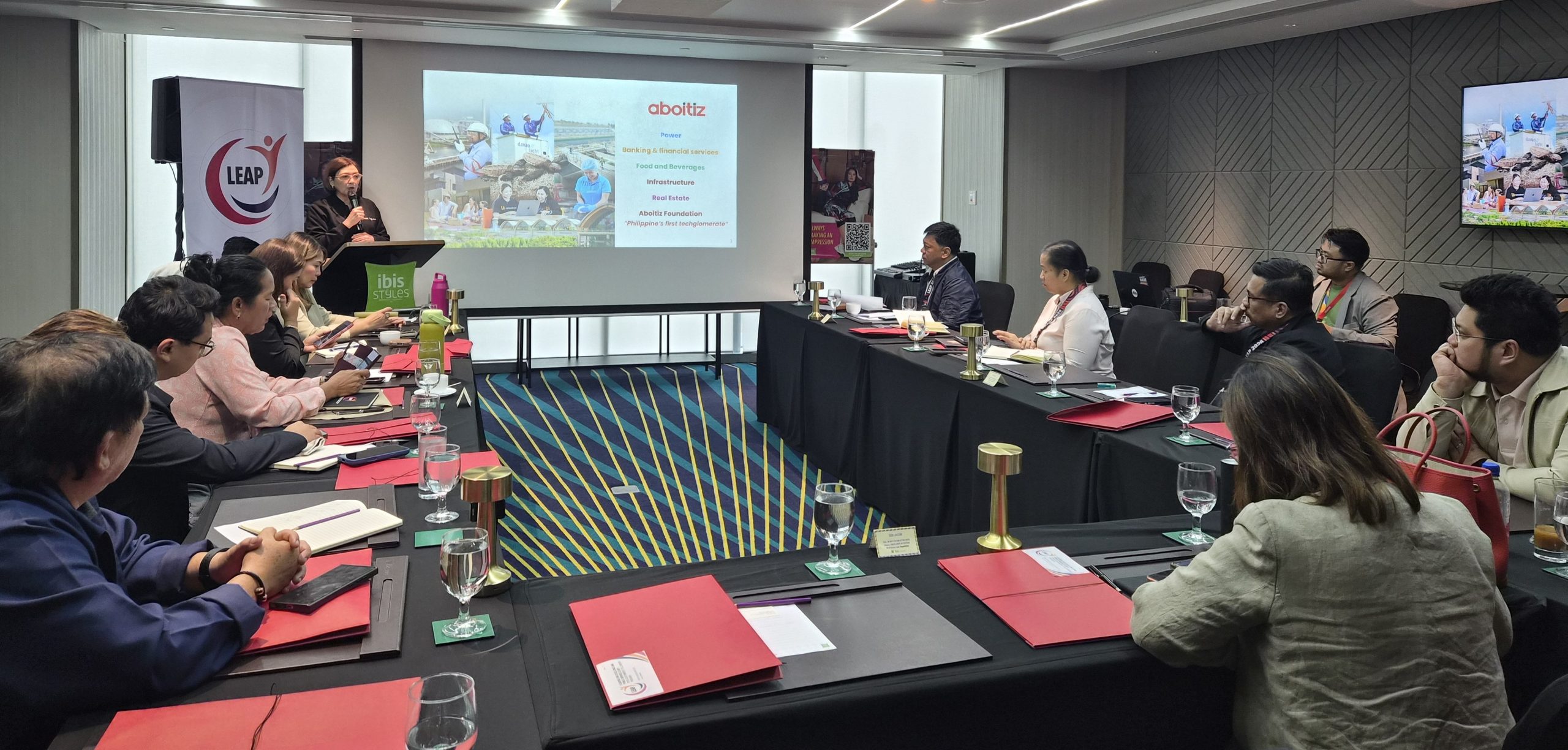
I am Ginggay Hontiveros Malvar, chief reputation and sustainability officer at Aboitiz Equity Ventures and also concurrently, president of Aboitiz Foundation.
The Aboitiz Group is one of the Philippines’ leading business groups, with interests in power, banking and financial services, food and beverages, infrastructure, and real estate. Guided by over a century of business excellence, Aboitiz is transforming into the Philippine’s first techglomerate, leveraging innovation, sustainability and good governance to create long-term value and drive positive change.
When I was asked to speak about governance, I have to admit that I hesitated a little. Not because governance is unimportant — quite the opposite. But because governance is one of those topics that people usually talk about only after something has gone wrong. We talk about governance after a corruption scandal, after a failed project, after an audit finding, or after public trust has been damaged. Very few people wake up in the morning excited to discuss governance.
And yet, after spending much of my career working with communities, local governments, regulators, investors, development partners and businesses across the country, I have come to believe that governance is often the difference between institutions that endure and institutions that struggle.
I also want to be upfront about something. I am not here to tell you how to run your municipalities. You know your realities far better than I do. You understand the political pressures, the resource constraints, the competing interests, and the everyday challenges that come with local leadership. What I can offer instead is a perspective from the private sector. I can share what we have learned at Aboitiz over more than a century of building businesses, navigating crises, transforming ourselves, partnering with governments and communities, and trying to remain relevant across generations.
Some of those lessons came from successes. Many came from mistakes and our own failures. And perhaps the most important lesson is this: governance matters most when there is pressure to ignore it.
Before I go further, let me start with the textbook definition. Governance is the system of rules, practices, and processes by which an organization or society is directed, controlled and held accountable. It defines who makes decisions, who holds authority, and how risks and performance are monitored.
Government is the institution. Governance is how the institution works.
In our case, Aboitiz is the institution. Governance is how decisions are made within that institution.
But over the years, I have come to think about governance much more simply. Governance is really about how institutions make decisions when things become difficult. Because when everything is going well, governance is easy. Governance is tested when there is pressure — pressure to move faster, pressure to make exceptions, pressure to avoid difficult conversations, pressure to prioritize immediate results over long-term outcomes. That is when governance stops being a policy and becomes a leadership discipline.
One of the reasons I care deeply about governance comes from the history of our own organization.
The Aboitiz Group is now more than one hundred years old. When people hear that, they often assume that longevity is simply the result of making good business decisions. Certainly that is part of the story. But as I reflect on our history, I have come to believe that what allowed the organization to survive wars, economic crises, political transitions, industry disruptions, technological change, and multiple generations of leadership was not simply strategy. It was the willingness to evolve the way decisions were made.
Like many family-owned businesses, there was a time when leadership and authority were concentrated among family members. That model worked when the organization was smaller and less complex. But as the business expanded into multiple industries and engaged with a growing number of stakeholders, the family had to confront a difficult reality. The future of the organization could not depend on the judgment of a few individuals alone.
At some point, the family had to ask itself a difficult question: Are we building a family business, or are we building an institution?
That sounds like an obvious question today, but it was not an easy one at the time. Because governance required giving up some control. It required accepting greater scrutiny. It required bringing in professional managers and empowering them to lead. It required giving independent directors meaningful oversight roles. It required creating stronger systems for risk management, succession planning, disclosure, accountability, cybersecurity, sustainability and reputation management.
Most importantly, it required accepting that the best ideas might come from people outside the family.
Looking back, many of those decisions were uncomfortable. Governance often is. It requires leaders to hear views they may not agree with. It requires decisions to be challenged. It requires accepting that no single person has all the answers. But those decisions strengthened the institution. They allowed the organization to become bigger than any one individual, any one family member, or any one generation.
And I think there is a lesson there for all leaders, whether in business or government. Every mayor eventually faces a version of the same question. Not about family, but about leadership. Are you building a municipality that depends on you, or are you building a municipality that can continue to succeed long after you have left office? Because leadership is temporary. Terms end. Administrations change. People move on. But institutions remain.
“Governance is tested when there is pressure — pressure to move faster, pressure to make exceptions, pressure to avoid difficult conversations, pressure to prioritize immediate results over long-term outcomes. That is when governance stops being a policy and becomes a leadership discipline.”
One of the biggest challenges we face in the Philippines is that we often build around personalities instead of institutions. Every election risks a reset. Every leadership transition risks losing momentum. Every change in administration risks starting over.
Good governance helps to protect continuity. It protects institutional memory. It protects progress. And one of the hardest lessons in leadership is this: Immature leaders want institutions to depend on them. Mature leaders build institutions that can thrive without them.
A second lesson we learned is that governance often feels inconvenient before it proves its value.
One thing I have observed from working on infrastructure projects, energy projects, community partnerships and transformation initiatives is that everybody wants speed. Investors want speed. Customers want speed. Project teams want speed. Communities want answers. The government wants results. Everyone wants things to move faster.
And many of the most difficult moments we have experienced happened precisely when governance forced us to slow down.
There have been projects where timelines were slipping, costs were increasing, and stakeholders were becoming impatient. Teams were under tremendous pressure to move forward. Yet governance required additional consultations, additional stakeholder engagement, additional reviews, and more scrutiny.
At those moments, governance may feel like an obstacle. People begin asking why another review is needed. Why more consultation is necessary. Why decisions cannot simply be made.
But over time, we learned something important. Almost every major crisis begins with someone saying, “Let’s skip this step.” “Let’s solve that later.” “Let’s make an exception.” And very often those shortcuts become expensive in the long run.
What begins as an attempt to save time can become a legal issue, a community issue, a regulatory issue, or a reputational issue. The cost of fixing a bad decision is usually far greater than the cost of making a careful one.
That is why one lesson we remind ourselves of repeatedly is this: Sometimes governance slows action, but it actually speeds up outcomes. What feels like a delay today may in reality prevent a crisis tomorrow.
We see this in the power sector. Building a power facility is not simply a matter of engineering and construction. Before a single shovel touches the ground, developers must secure permits from dozens of agencies, obtain hundreds of approvals and signatures, comply with numerous laws, and engage stakeholders every step of the way.
It is easy to look at that process and think, “This is taking too long.” But imagine the alternative. Imagine building first and addressing environmental concerns, community issues, or regulatory requirements later. What appears to be a delay today could become a legal battle, a community dispute, or a reputational crisis tomorrow.
That is why governance matters. It may slow decisions in the short term, but it accelerates sustainable outcomes in the long term.
A third lesson emerged during our own transformation journey.
A few years ago, Aboitiz made the strategic decision to become the country’s first techglomerate. Like many organizations embarking on digital transformation, we initially assumed that technology would be our biggest challenge.
What we discovered was something quite different. Technology was not the hardest part. Governance was one of our bigger challenges.
As new technologies emerged and business units pushed for faster innovation, the pressure to move quickly became intense. Everyone wanted solutions. Everyone wanted speed. Everyone wanted results. Yet many of the challenges we encountered were not technology failures. They were governance challenges.
Questions around data ownership. Questions around cybersecurity. Questions around accountability. Questions around decision rights. Questions around how risks would be managed and who would ultimately be responsible for decisions. These questions were so important especially since we were already operating under a new business model, one of federation where our business units were given autonomy to operate independently of the parent company.
We learned that technology transformation without governance creates bigger problems later. Poor data quality, cybersecurity vulnerabilities, compliance risks, failed adoption, costly rework and loss of trust can all result when governance does not keep pace with innovation. Technology did not eliminate the need for governance. If anything, it increased the need for governance.
“Are you building a municipality that depends on you, or are you building a municipality that can continue to succeed long after you have left office? Because leadership is temporary. Terms end. Administrations change. People move on. But institutions remain.”
And I suspect many of your municipalities will encounter similar challenges in the years ahead as digitalization, artificial intelligence, smart city initiatives, and technology-enabled public services become more common.
Technology can accelerate progress. But technology cannot compensate for weak governance. In many cases, it simply exposes weaknesses that already exist. So pay attention to that.
Let me now connect governance to something that I know many of you care deeply about: economic development.
Whenever I meet local government leaders, the conversation often turns to attracting investments, creating jobs, and generating economic opportunities. These are among the most important responsibilities of local leadership.
Many people assume that companies choose where to invest primarily because of incentives. Of course, incentives matter. Infrastructure matters. Market opportunities matter.
Let me share what we have learned in the private sector.
One reason Aboitiz has been able to attract and build partnerships with respected global institutions such as JERA, Citi, Global Infrastructure Partners, Coca-Cola Europacific Partners, and many others is not simply because of business opportunities. These organizations can partner with companies all over the world. What they are evaluating is not only the opportunity. They are evaluating the quality of the institution itself.
They want to understand how decisions are made. They want to understand how risks are managed. They want confidence that commitments will be honored. They want confidence that leadership transitions will not fundamentally change the rules of engagement. They want confidence that there is transparency, accountability, and predictability.
In many ways, governance becomes a competitive advantage. It lowers uncertainty. It strengthens trust and confidence. And it makes partnership possible.
I often say that good governance does not guarantee success. But poor governance makes long-term success very difficult. The same principle applies to municipalities. Investors may be attracted by incentives, but they stay because they trust the institution. They stay because the rules are predictable. They stay because commitments are honored. They stay because they know that even when leadership changes, the municipality remains reliable.
That is governance in practice.
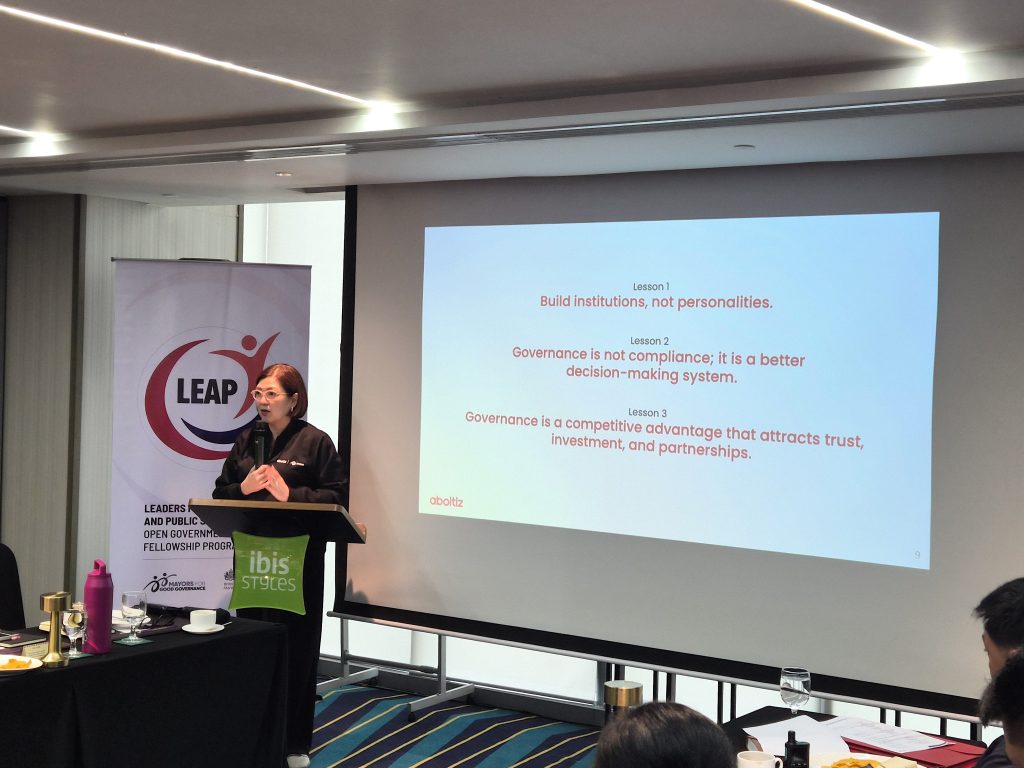
So let me leave you with the three lessons that have stayed with me from our experience at Aboitiz, and which I hope might be useful in your own leadership journey.
Lesson 1.Build institutions, not personalities.
One of the reasons Aboitiz has survived and evolved for more than one hundred years is because successive generations made a conscious decision to build systems that were stronger than any individual leader. As mayors, you will be remembered for the projects you build, but your lasting legacy will be the institutions you strengthen. The true test of leadership is not whether things work while you are in office. It is whether they continue to work after you are gone.
Lesson 2. Governance is not compliance; it is a better decision-making system.
In the private sector, we have learned repeatedly that governance often feels inconvenient. It slows us down, asks difficult questions, and forces us to examine risks that we would rather ignore. Yet when we look back at our most difficult challenges, we often realize that governance was not the obstacle. It was the safeguard. Good governance helps protect the future from the pressures of the present. It helps leaders make decisions that are not only fast, but also fair, sustainable and responsible.
Lesson 3. Governance is a competitive advantage that attracts trust, investment, and partnerships.
Over the years, Aboitiz has been able to attract world-class partners such as JERA, Citi, Global Infrastructure Partners, Coca-Cola Europacific Partners, and many others. Those partnerships were not built on opportunity alone. They were built on confidence. Confidence in our systems. Confidence in our decision-making. Confidence that commitments would be honored. The same principle applies to your municipalities. Investors may be attracted by incentives, but they stay because they trust the institution. In a world where uncertainty is increasing, predictability and credibility have become powerful assets.
So if there is one thing I hope you remember from our conversation today, it is that governance is ultimately about building institutions that can solve problems consistently, earn trust through performance, and create value long after any individual leader has moved on.
After more than 100 years, one thing the Aboitiz Group has learned is that institutions are built one decision at a time. Not one project at a time. Not one leader at a time. One decision at a time.
Governance is not a document. It is not a committee. It is not a policy manual sitting on a shelf. Governance is the discipline of making good decisions repeatedly, especially when it would be easier not to.
The Philippines does not lack talent. It does not lack ideas. It does not lack opportunity. What we need are stronger institutions. Institutions that can execute consistently over time. Institutions that can survive leadership transitions. Institutions that can earn trust because they are accountable for the results they deliver. Institutions that can solve problems long after their leaders have moved on. Institutions that people can trust.